An Interview with Sandra Nickel, Author
At Little House of Science, choosing what we teach is never simply a question of covering another scientific topic. We want children to encounter the people behind the discoveries, the questions they asked, the evidence they followed and, importantly, the moments when they were prepared to look at something differently.
That is why this term we designed a lesson around Vera Rubin. Rubin’s work offers children a remarkable way into some of the biggest questions in modern astronomy. By studying the movement of stars within galaxies, she helped provide compelling evidence for something we cannot see directly: dark matter. But we wanted the children to encounter more than the discovery itself. We wanted them to meet the scientist behind it, someone who paid attention when observations did not fit expectations, who was willing to question established assumptions, and whose curiosity remained central to the way she approached the universe.
For us, that feels particularly important today. Children are growing up with extraordinary access to information, and increasingly to instant answers. Science education therefore cannot be only about knowing more facts. It must also teach children to ask: How do we know this? What is the evidence? What if what we observe doesn’t fit what we expected? Could there be another explanation?
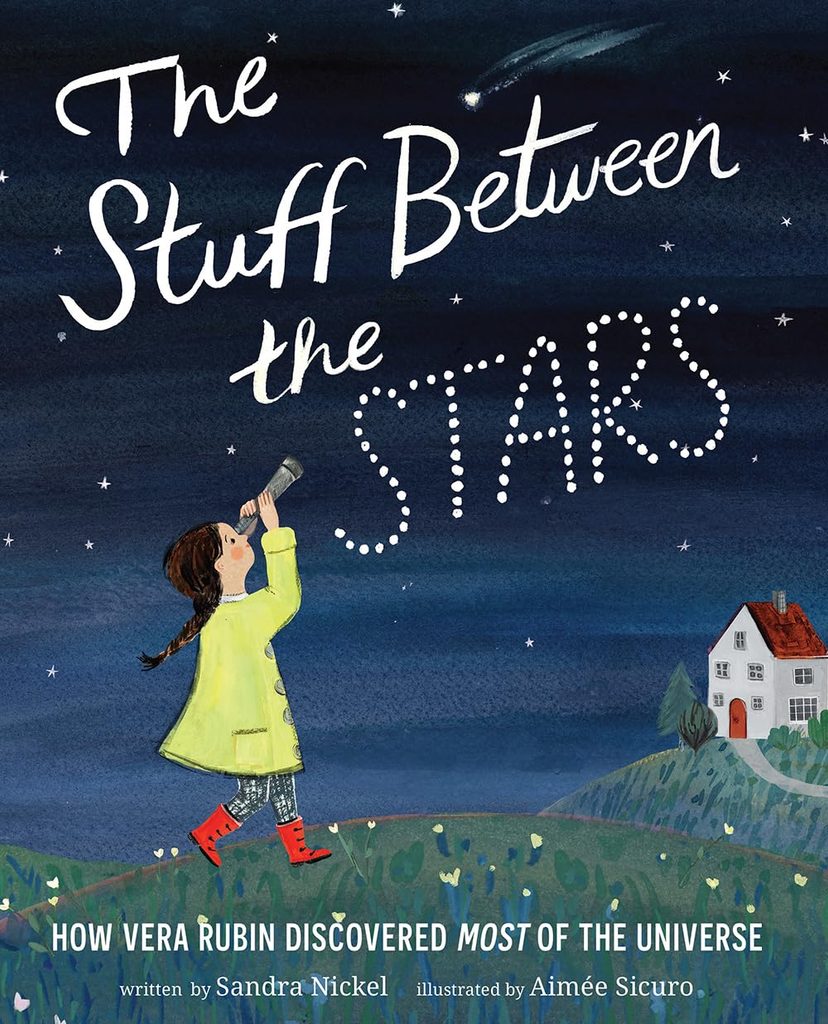
We invited Sandra Nickel, author of The Stuff Between the Stars: How Vera Rubin Discovered Most of the Universe, to join us for a conversation about the remarkable life and work of Vera Rubin.
Sandra’s book brings Vera Rubin’s story and the science of dark matter to life for young readers through the power of storytelling. We were curious to discover how you take the life and complex science of an astrophysicist and make both meaningful to children without losing what makes them extraordinary.
We spoke with Sandra about Vera Rubin, writing science for children, the importance of curiosity and critical thinking, and the place of books in a childhood increasingly surrounded by technology and AI.
Here is our conversation.
Liliana Crachilova
Co Founder & Director, Little House of Science
LHS: At Little House of Science, we chose to dedicate a lesson to Vera Rubin because we felt that children should encounter not only her extraordinary contribution to our understanding of the universe, but also the scientist herself. What first drew you to Vera Rubin, and what made you feel that her story needed to be told to children?
Sandra Nickel: I first learned about Vera when I read a New York Times article about what a shame it was that she had died before she received a Nobel Prize. I thought to myself, I can’t give her a Nobel Prize, but I can tell children about her so they know how incredible she was as a scientist and person.
LHS. Writing about an astrophysicist for young children must involve some fascinating choices. How did you go about researching Vera’s life and her science, and what was the most challenging part of turning such a complex story into a book for children?
Sandra Nickel: Scientists were enthralled by Vera’s discoveries, so she was interviewed many times. Luckily for me, several of these interviews were recorded. It was such a gift to hear Vera talk about her own life and work.
As you’ve guessed, it was challenging to explain the complex discovery of dark matter in a way that is easy to understand. In fact, I discovered even many adults didn’t understand the concept. So I tried and tried again, asking different friends to read, until they all wrote back saying more or less, Wow, this is the first time I finally understand what Vera Rubin did.
LHS: During your research, was there something you discovered about Vera, perhaps a small detail about her character, her life, or the way she worked, that particularly surprised you or stayed with you?
Sandra Nickel: In her interviews, Vera talked about working while she was expecting and also about how she worked at night, after her family had gone to bed. I was struck by her dedication to being both a mother and a scientist. It is one of the loveliest parts of her story. In The Stuff Between the Stars you can see her working as her children sleep on page 12. And I especially love the illustration on page 8 of her working as she is pregnant. I believe it is the only illustration of a working, expecting mother in a children’s nonfiction book.
LHS: Vera Rubin was prepared to take seriously observations that did not fit what astronomers expected to see. In a world where children are surrounded by an unprecedented amount of information, including AI-generated answers, what can her approach teach them about critical thinking: questioning assumptions, evaluating evidence and being prepared to change their minds?
Sandra Nickel: Recently, I was speaking to a professor at Berkeley University, one of the leading universities in the United States. She said she could always tell when students had used AI, because they all said the same thing. They had all been given the same summary of facts. One of the most admirable things about Vera is that she never thought there was one, never changing way to see the world. She was always looking for a new way to look at things. Today more than ever, what makes someone standout is that they don’t simply accept what someone else tells them. What makes them remarkable is that they are brave enough to look beyond the obvious and see things in a new way.
LHS: Many of the parents reading this will be wondering how to keep children curious and engaged with books in a world increasingly shaped by screens, technology and AI. What do you think a beautifully told science story can give a child that they might not find elsewhere?
Sandra Nickel: The authors of science stories spend a long time with their subjects. For me, I read and thought about Vera for over a year. This allowed me to see that her life paralleled her work, something that nobody else had talked about.
Because Vera had been taking care of her children, she chose to investigate stars nobody else was interested in, the slow moving stars at the edge of the galaxies. The scientists at the center of the big issues of the day viewed Vera as also being slow-going, at the edge of their galaxy. But when Vera proved that the stars on the edge of the galaxies move just as fast as those at the center, the scientists realized that Vera had in fact been moving just as fast as they had. She was no longer at the edge of astronomy, she was at its center. In fact, she had transformed modern physics and astronomy.
With a science picture book, the story also comes with extraordinary illustrations. In the case of The Stuff Between the Stars, the art by Aimee Sicuro, who also spent over a year illustrating, is stunning. A child may hold the book in their hands, turn the pages back and forth, and discover different things each time they read it.
LHS: And finally, if you could sit down with Vera Rubin for a cup of tea and ask her one question that your research never answered, what would it be?
Sandra Nickel: I would love to chat with Vera about her childhood. The hardest research question all nonfiction authors face is what their person was like as a child. Historians rarely keep track of that. I was lucky to have Vera’s interviews where she talked about growing up. But I would love to know what her favorite star was, if her parents ever caught her staying up late, and how far she could see with that amazing telescope she made out of a cardboard tube.
About Sandra Nickel
Sandra Nickel writes stories about unexpected friends, women who did the impossible, people who were (almost) forgotten, and the unexpected truths about those we think we already know. Her most recent picture book is The True Ugly Duckling: How Hans Christian Andersen Became a Swan.
You may find Sandra’s books at Amazon.