
February Half Term 2027 • Ages 5 to 13
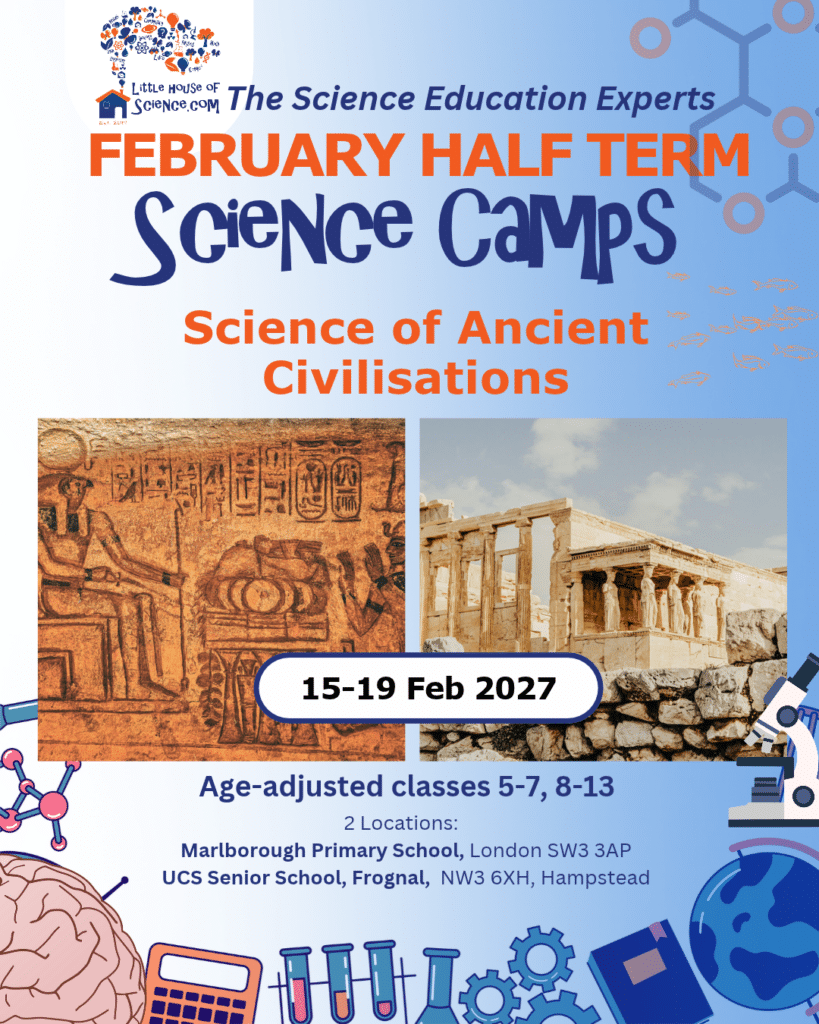
The History of Science: Ancient Civilisations
Long before laboratories, computers and modern technology, people were already asking extraordinary questions about the world around them, and finding ingenious ways to answer them.
This five-day journey takes children across some of the world’s great ancient civilisations, uncovering the science, engineering and ideas that shaped human history. From paper, maps and the compass in Ancient China, to Archimedes, atomic theory and early medicine in Ancient Greece; from the remarkable engineering of the Egyptians, to the cities, farming systems and discovery of rubber in the Americas; and finally to the extraordinary inventions of Ancient India and Rome.
A journey through time
Stop 1
Ancient China
Paper, maps and the compass
Stop 2
Ancient Greece
Archimedes, atomic theory and early medicine
Stop 3
Ancient Egypt
The remarkable engineering of the Egyptians
Stop 4
The Americas
Cities, farming systems and the discovery of rubber
Stop 5
Ancient India & Rome
Extraordinary inventions, including Roman concrete and aqueducts
Children will explore how people understood forces, flight, earthquakes, materials, medicine, astronomy, water and architecture, while discovering the stories behind inventions such as the seismograph, kite, rockets, Roman concrete, aqueducts and water mills.
Inventions we will uncover
- Seismograph
- Kite
- Rockets
- Roman concrete
- Aqueducts
- Water mills
At the heart of the week is a simple but powerful idea:
Science did not begin in a modern laboratory. It began with human curiosity.
Across different cultures and thousands of years, people observed the world, asked questions, tested ideas and invented solutions to the problems they faced. This journey gives children the opportunity to see science not as a collection of discoveries, but as part of the long human story of curiosity, ingenuity and the desire to understand our world.
Everything you need to know
Dates & times
- Monday 15 to Friday 19 February 2027
- Camp runs 9.30am to 3.30pm
- Late pick-up available, booked separately
Prices
- £585 for the full week
- Book daily or weekly
- 10% sibling and friends discount, applied automatically
Ages & groups
- Ages 5 to 7 and 8 to 13, taught separately
- 1 teacher to every 6 children
- Hands-on and project-based, with take-home projects every day
Venues
- UCS Senior School, Frognal, Hampstead, London NW3 6XH
- MPW School London, 65-67 Queen’s Gate, South Kensington, London SW7 5JS
Questions parents ask
Is this camp right for my 5 year old?
Yes. Children aged 5 to 7 and 8 to 13 are grouped and taught separately, so every activity is pitched at the right level.
Can I book single days?
Yes. You can book daily or for the full week, at either venue.
Is there a sibling discount?
Yes. We offer a 10% siblings and friends discount, applied automatically when you book.
What should my child bring?
Please pack a snack, due to different dietary requirements. We do not allow any nuts, seeds or eggs in the room.
February half term • 15 to 19 February 2027
Ready to travel back in time?
Five days, five ancient civilisations and a week full of hands-on discovery. Choose your venue and your days, and we will take care of the wow.