
Six experiments • Six printable downloads
Spooky science.
Curious minds.
Halloween experiments from Little House of Science: bubbling brews, dancing ghosts, balloon rockets, melting ghosts, pumpkin volcanoes and a vampire’s potion. Choose an experiment below, check its materials card and follow the steps. Open the full materials list for quantities, or select a visual to download its original activity sheet.
Choose your experiment
Experiment 01
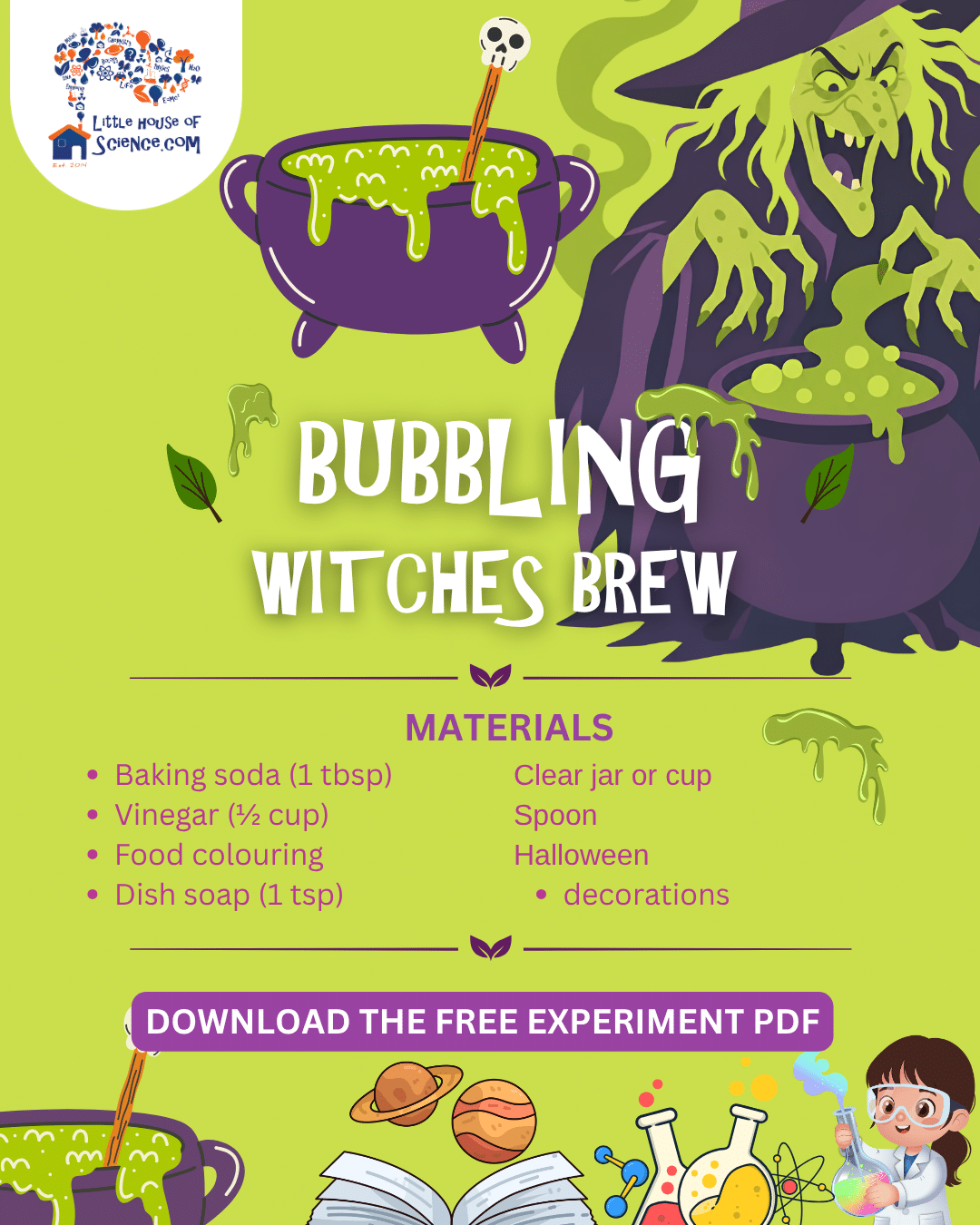
Bubbling Witches Brew
Create a spooky, bubbling potion that will fizz and foam like a witches brew!
Full materials and quantities
- Baking soda (1 tablespoon)
- Vinegar (½ cup)
- Green or purple food colouring
- Dish soap (1 teaspoon)
- A clear jar or cup
- A spoon
- Halloween decorations (plastic spiders, toy eyeballs, etc.)
Instructions
- Start by decorating your jar or cup with Halloween-themed stickers, creepy faces, or place some plastic spiders and toy eyeballs around and inside it to make it extra spooky.
- Fill the jar about halfway with vinegar. Add a few drops of food colouring to make it look like a magical potion—green or purple works best for a witch’s brew!
- Squirt a teaspoon of dish soap into the mixture and stir gently with a spoon.
- Now, for the fun part! Add a tablespoon of baking soda to the jar and watch your witch’s brew bubble and fizz over the top like a magical potion coming to life!
- If the bubbling stops, add more baking soda or vinegar to keep the fun going.
The Science Behind the Experiment
When baking soda and vinegar combine, they create a chemical reaction that produces carbon dioxide gas, which causes all the bubbles to form and foam up. The dish soap traps the gas bubbles, creating lots of frothy foam. This fun Halloween experiment helps kids understand how different substances react with each other to create new things—like a witches brew that bubbles and fizzes!
Definitions
- Chemical Reaction: When two or more things mix together and create something new.
- Carbon Dioxide: A gas that is made when baking soda and vinegar mix, causing bubbles.
- Fizzing: The bubbling sound and action made by gas escaping from a liquid.
Experiment 02
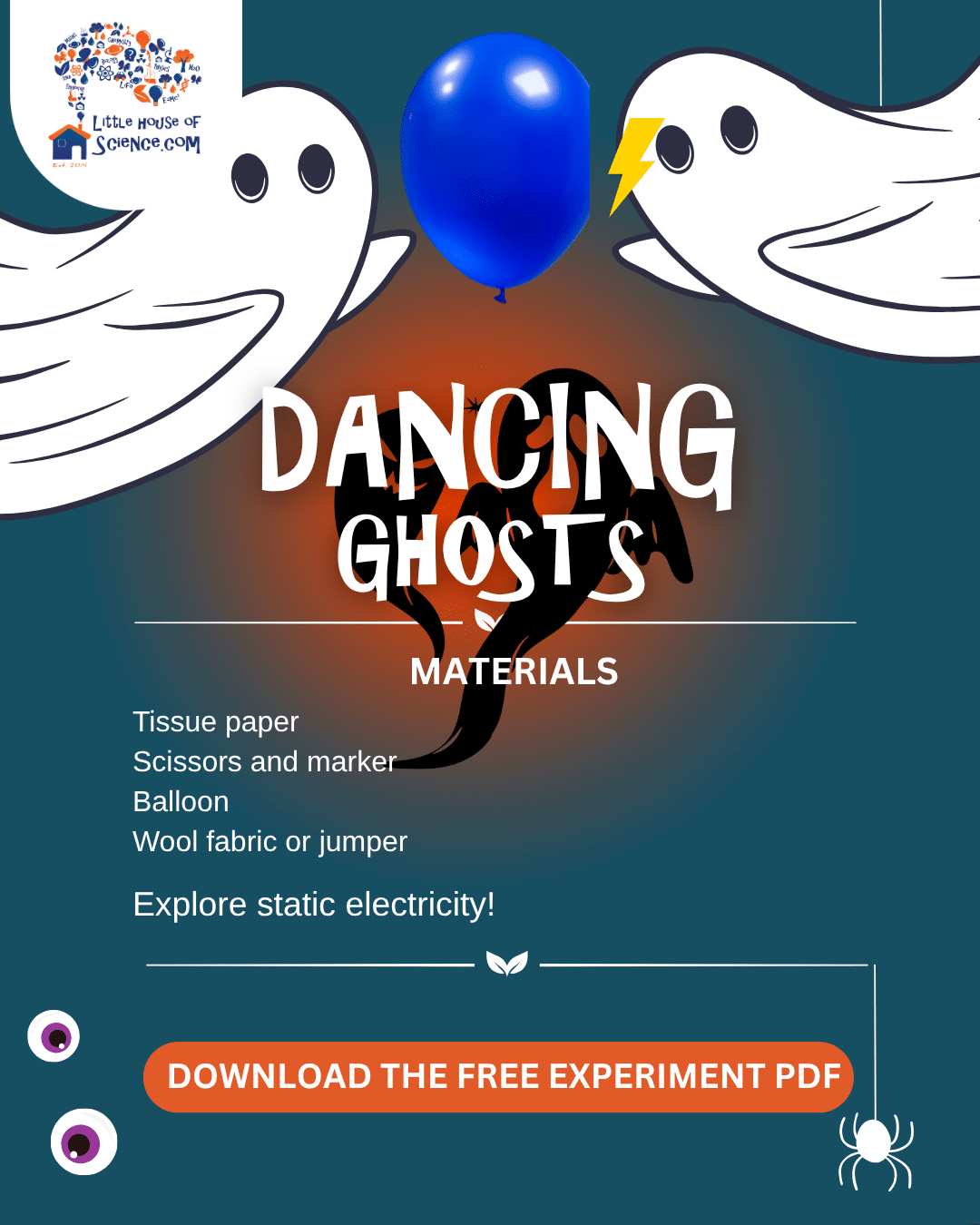
Dancing Ghosts
Make spooky paper ghosts float and dance in the air using static electricity!
Full materials and quantities
- Tissue paper or thin paper
- Scissors
- A balloon
- A marker
- A sweater or wool fabric
- Halloween stickers or decorations (optional)
Instructions
- Use the tissue paper to cut out small ghost shapes. You can add a spooky face to your ghosts with a marker or decorate them with Halloween stickers.
- Blow up the balloon and tie it off. Decorate the balloon with Halloween drawings if you like!
- Rub the balloon on a jumper, wool fabric, or even your hair for about 30 seconds to build up static electricity.
- Hold the balloon close to the tissue paper ghosts without touching them. Watch as the static electricity makes the ghosts rise and dance in the air like magic!
- If the ghosts fall, rub the balloon again to recharge it and make them float some more!
The Science Behind the Experiment
Rubbing the balloon against the sweater creates static electricity, which happens when tiny particles called electrons build up on the surface of the balloon. When you bring the balloon near the tissue paper ghosts, the static electricity pulls on them, making them lift up and float. This experiment teaches kids about static electricity and how invisible forces can make things move in surprising ways.
Definitions
- Static Electricity: A type of electricity that builds up on an object and can pull or push other things.
- Electrons: Tiny particles that carry electricity and can jump from one thing to another.
- Attract: When two objects are pulled toward each other by an invisible force.
Experiment 03
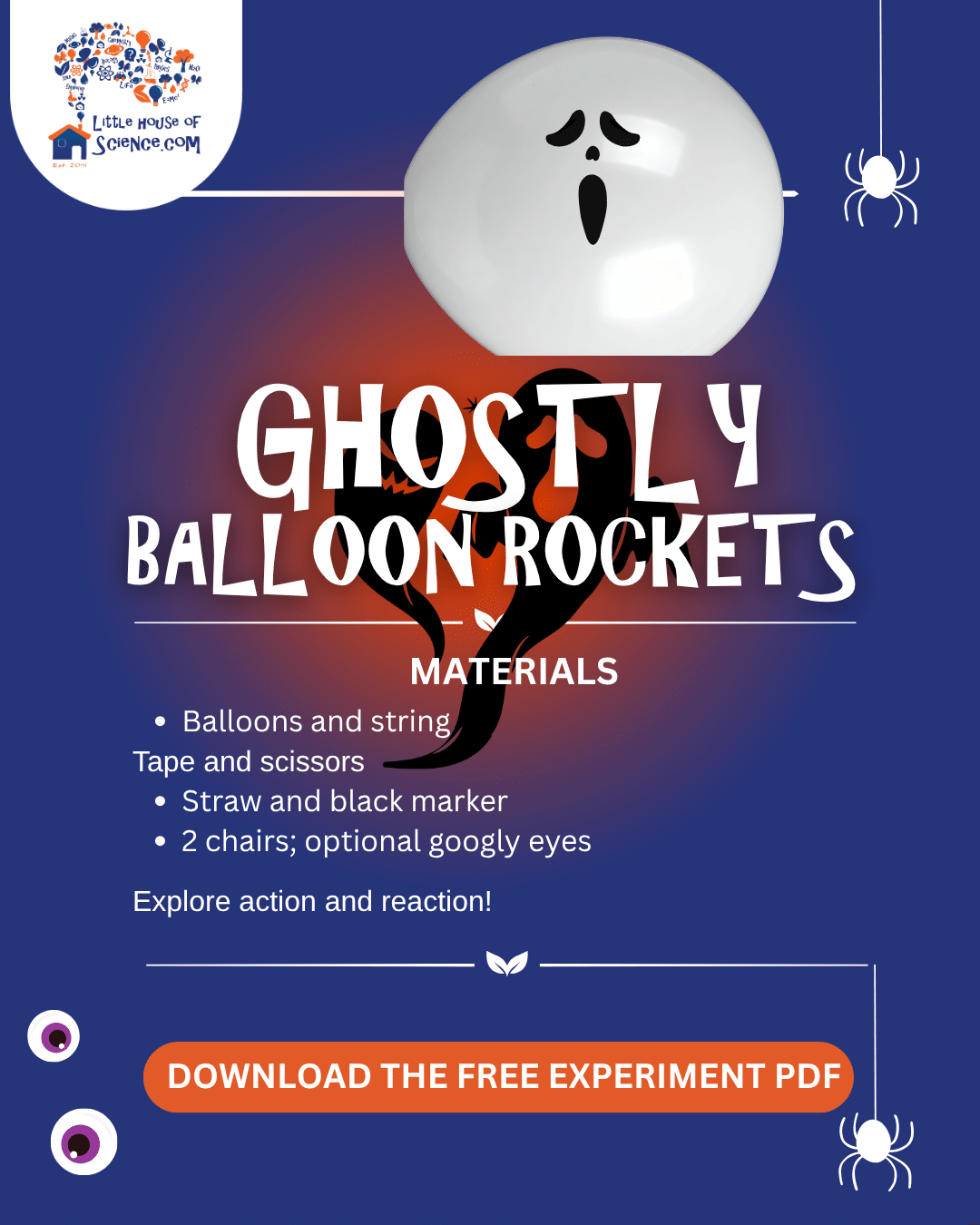
Ghostly Balloon Rockets
Create a spooky rocket to zoom across the room with the power of air!
Full materials and quantities
- Balloons (white or glow-in-the-dark for a ghostly effect)
- String (about 3-5 metres long)
- Tape
- Scissors
- Straw
- Black marker
- 2 Chairs or objects to tie the string to
- Optional: Googly eyes and paper for ghost decorations
Instructions
- Decorate your balloon by drawing a ghostly face on it with a black marker, or tape on some googly eyes for extra spookiness. You can even cut out ghost shapes from paper and tape them to the balloon!
- Cut a long piece of string and thread it through a straw. The straw will be your rocket slider.
- Tie each end of the string to two sturdy objects (like chairs or doorknobs) so that the string is stretched tightly across the room. This will be your rocket’s “track.”
- Blow up the ghost balloon, but don’t tie it! Pinch the end to keep the air from escaping.
- Tape the balloon to the straw, holding the balloon closed at the same time.
- When you’re ready for liftoff, release the balloon and watch it zoom along the string like a ghostly rocket!
The Science Behind the Experiment
When you release the air from the balloon, it rushes out the back, pushing the balloon forward. This is a simple demonstration of Newton’s third law of motion: for every action, there is an equal and opposite reaction. The air moving one way forces the balloon to move the other way. This fun activity helps kids understand how forces and motion work while getting them excited about the science of rockets!
Definitions
- Force: A push or pull on an object that makes it move.
- Motion: The movement of something from one place to another.
- Reaction: What happens when one thing pushes on another thing, making it move in the opposite direction.
Experiment 04
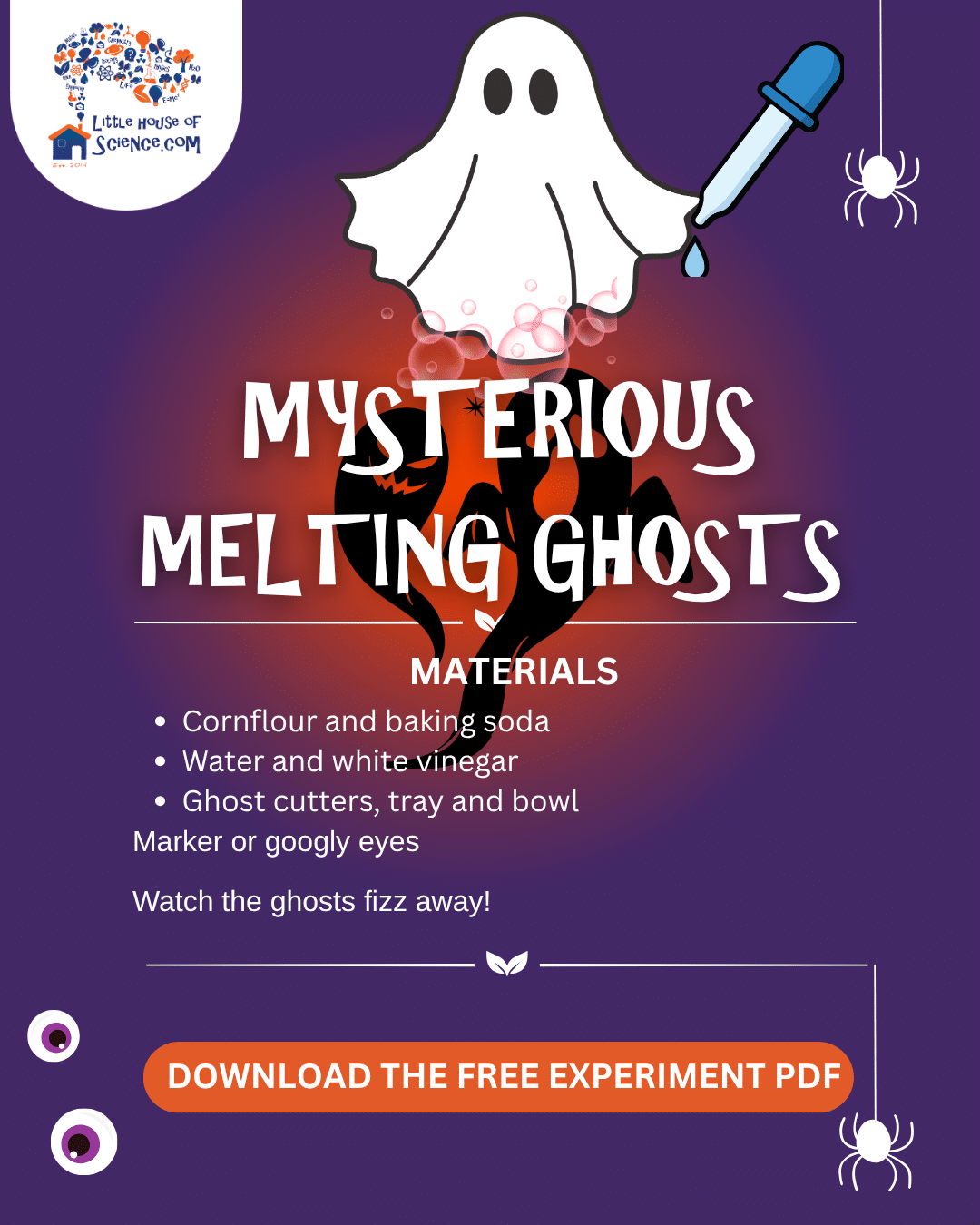
Mysterious Melting Ghosts
Watch as spooky ghosts disappear in a magical melting experiment!
Full materials and quantities
- Cornflour (240ml/1 cup)
- Baking soda (120ml/½ cup)
- Water (120ml/½ cup)
- White vinegar (240ml/1 cup)
- Ghost cookie cutters or your hands to shape the ghosts
- Black marker or googly eyes
- Tray or plate
- Small bowl or cup
Instructions
- Mix the cornflour and baking soda together in a bowl to form a dough-like mixture. Slowly add water while stirring until the mixture becomes mouldable, like clay.
- Shape the dough into ghost shapes using cookie cutters or your hands. You can make the ghosts as spooky as you like! Place them on a tray or plate.
- Add black marker dots for eyes or stick on googly eyes to bring your ghosts to life!
- Let your ghosts sit for a while to harden—about 30 minutes to an hour works best.
- Once the ghosts are ready, pour some vinegar into a small bowl or cup.
- Pour the vinegar over your ghost and watch it fizz, bubble, and mysteriously disappear as if melting into thin air!
The Science Behind the Experiment
This experiment shows how a chemical reaction between baking soda and vinegar creates carbon dioxide gas, causing the bubbling and fizzing that makes the ghosts seem to melt away. The combination of vinegar (an acid) and baking soda (a base) is a fun way for kids to learn about chemical reactions while making a spooky ghost disappear!
Definitions
- Acid: A substance that can cause a chemical reaction when mixed with a base, like vinegar.
- Base: A substance that reacts with an acid to create bubbles and fizz, like baking soda.
- Chemical Reaction: When two or more substances mix and change, like making bubbles and melting ghosts!
Experiment 05
Pumpkin Volcano Eruption
Learn about how different substances can react together to create fascinating results!
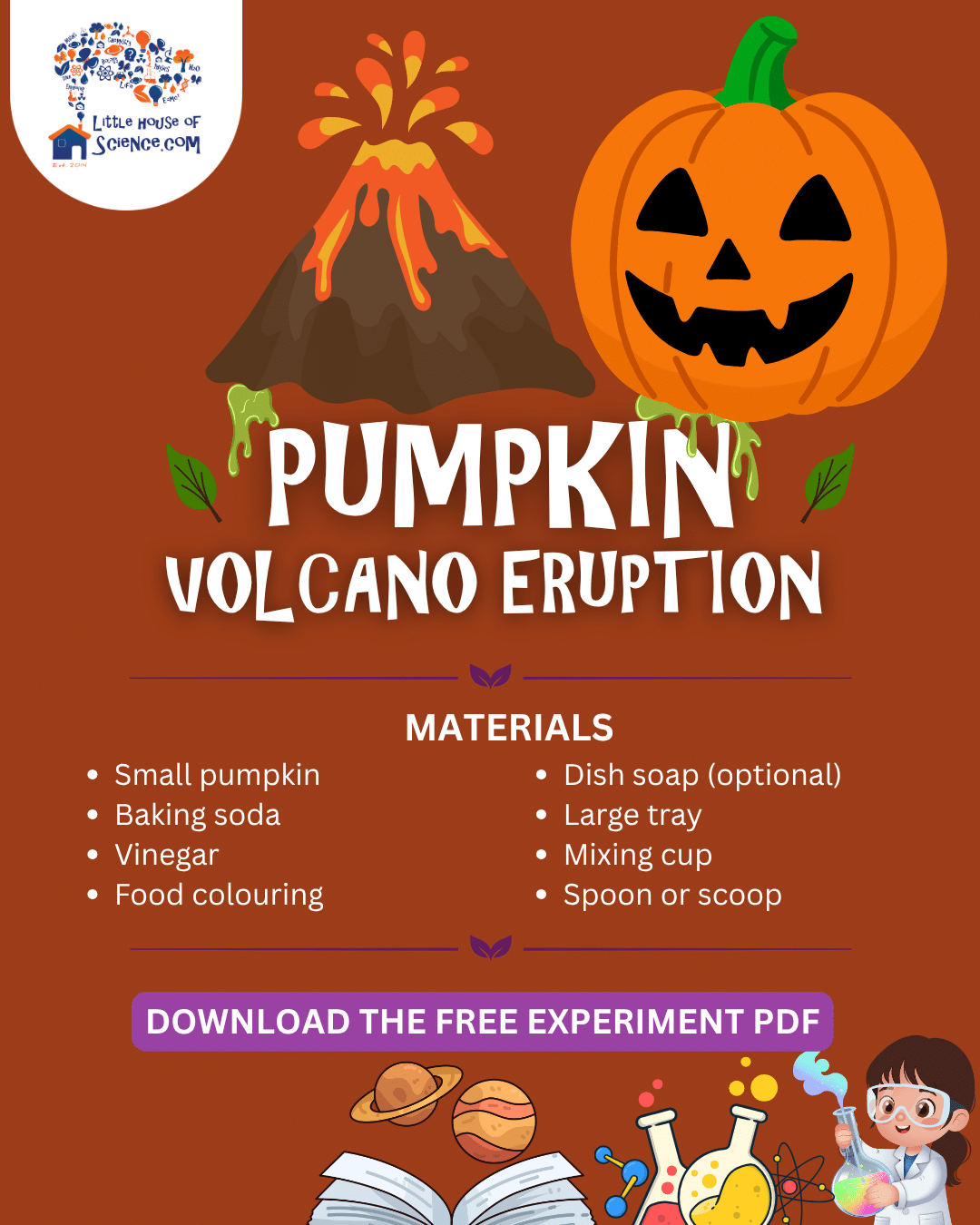
Full materials and quantities
- Small pumpkin (or mini pumpkin)
- Baking soda
- Vinegar
- Red and yellow food colouring (optional, for lava effect)
- Dish soap (optional, for extra bubbles)
- Large tray or baking sheet
- Small cup or container (for mixing)
- Spoon or small scoop
Instructions
- Cut off the top of the pumpkin and scoop out the seeds and stringy insides. You should be left with an empty pumpkin shell (you can also carve the pumpkin if you wish). Place the pumpkin on a large tray or baking sheet to catch any spills.
- Spoon a few tablespoons of baking soda into the bottom of the pumpkin. You can add more if you want a bigger eruption.
- In a small cup or container, mix vinegar with a few drops of red and yellow food colouring (for a lava effect) and a small squirt of dish soap (for extra bubbles).
- Pour the vinegar mixture into the pumpkin over the baking soda. Watch as the mixture starts to bubble and fizz, creating a fun eruption effect!
- Observe how the bubbling action mimics a volcanic eruption. Talk about why the bubbles happen and what is causing the eruption.
The Science Behind the Experiment
This experiment demonstrates an acid-base reaction between baking soda (a base) and vinegar (an acid). When combined, they produce carbon dioxide gas, which creates the bubbling and fizzing effect. The food colouring and dish soap enhance the visual and bubbly effect, making it look like lava erupting from a volcano. By watching the pumpkin erupt, children can see how chemical reactions work in a simple and exciting way. It helps them understand basic concepts like reactions and gases while providing a hands-on and interactive experience.
Definitions
- Reaction: When two or more substances combine and create a change, like bubbling.
- Carbon Dioxide: A gas that forms during this reaction and creates bubbles.
Experiment 06
Vampire’s Blood Potion
Create a spooky vampire’s potion that separates and swirls like magical, moving blood!
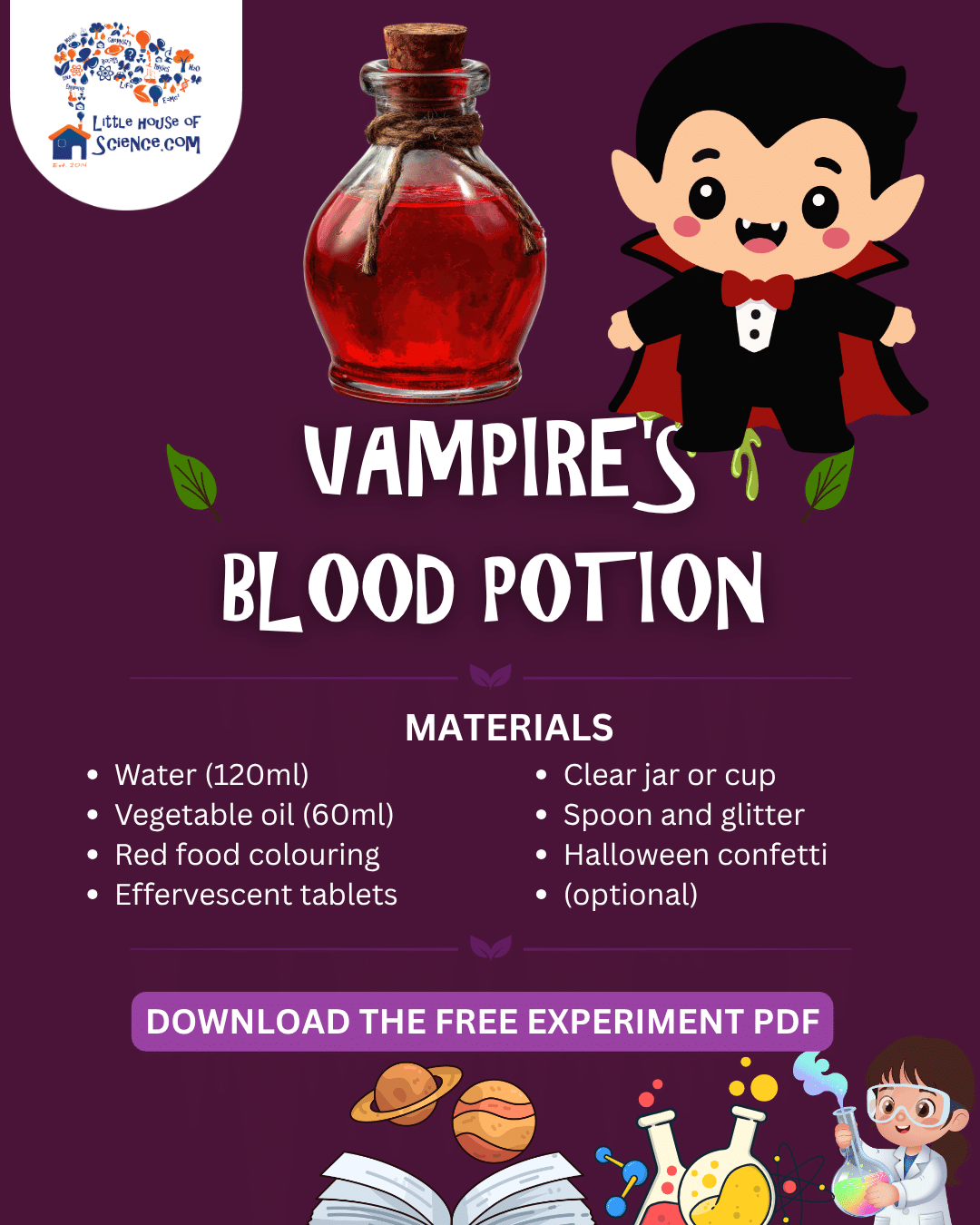
Full materials and quantities
- Clear jar or cup
- Water (120ml/½ cup)
- Vegetable oil (60ml/¼ cup)
- Red food colouring
- Alka-Seltzer tablets (or other effervescent tablets)
- Spoon
- Glitter
- Halloween-themed confetti (optional)
Instructions
- Fill your clear jar or cup about halfway with water. Add several drops of red food colouring and stir to make it look like blood.
- Add your glitter to the red water.
- Slowly pour the vegetable oil into the jar. The oil will float on top of the water, creating two layers.
- For extra spookiness, you can sprinkle some Halloween-themed confetti (like tiny bats or ghosts) into the mix.
- Now, break an Alka-Seltzer tablet into a few small pieces.
- Drop one piece into the jar and watch as bubbles form, causing the “blood” to swirl and move up and down like a magical vampire potion!
- Keep adding more tablet pieces to keep the spooky effect going.
The Science Behind the Experiment
This experiment shows how liquids of different densities don’t mix—oil floats on top of water because it’s less dense. When you drop in the Alka-Seltzer, it reacts with the water to create carbon dioxide gas, which forms bubbles that carry some of the coloured water upwards through the oil, creating a swirling “blood” effect. It’s a fun way to teach kids about density, chemical reactions, and the spooky science behind bubbles!
Definitions
- Density: How heavy or light something is compared to how much space it takes up—like oil floating on water because it’s less dense.
- Chemical Reaction: When two substances mix and change, like making bubbles in water.
- Effervescent: Something that fizzes or bubbles when mixed with water, like an Alka-Seltzer tablet.
Keep the science going
Choose another experiment, or save the original PDF activity sheets to try later. Each download includes the supplied activity text and illustrations.