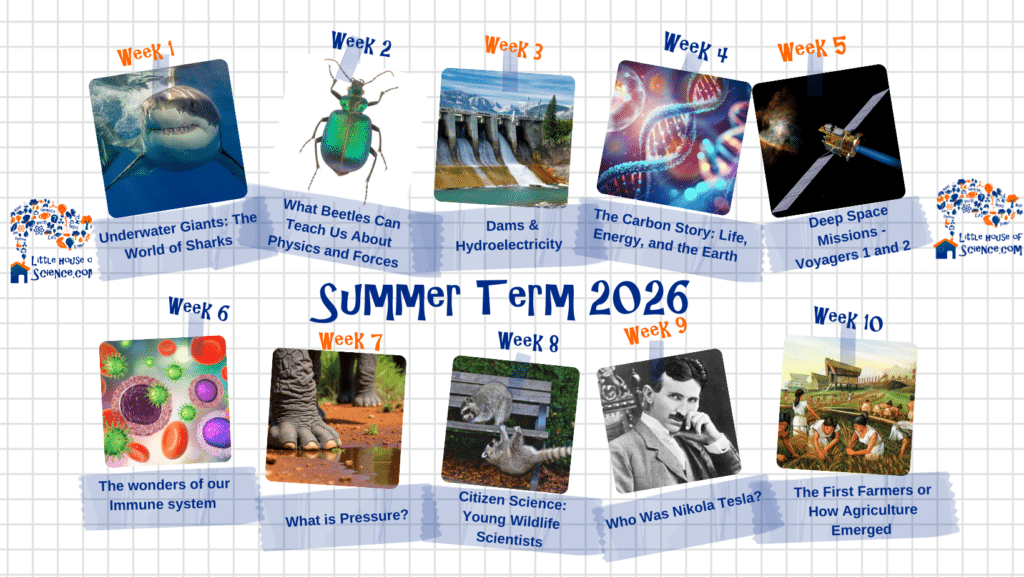
- Underwater Giants: The World of Sharks
- What Beetles Can Teach Us About Physics and Forces
- Dams & Hydroelectricity
- The Carbon Story: Life, Energy, and the Earth
- Deep Space Missions_ Voyagers 1 and 2
- The wonders of our Immune system
- What is Pressure?
- Citizen Science: Helping Real Scientists
- Who Was Nikola Tesla?
- The First Farmers or How Agriculture Emerge
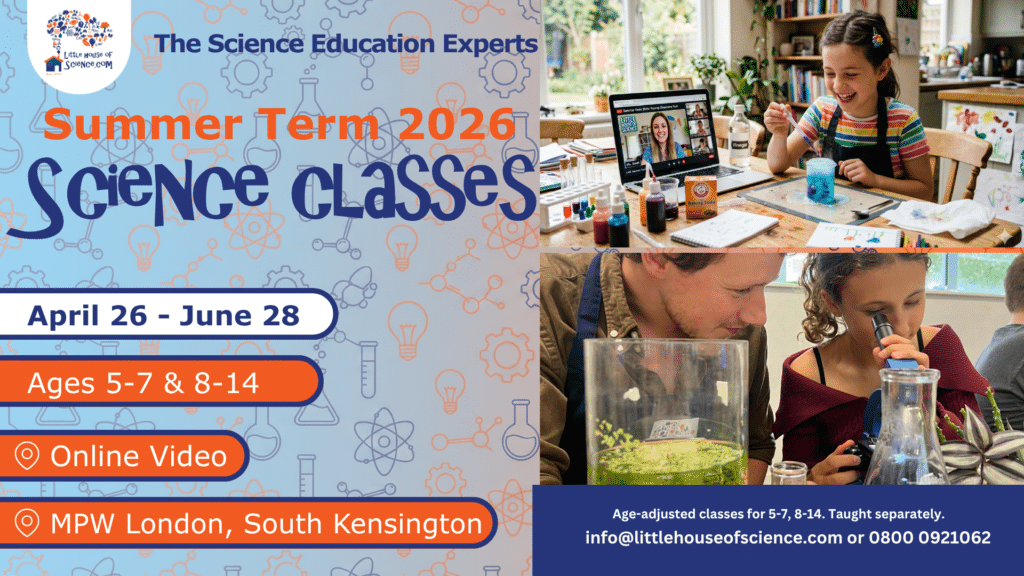
Our Summer Term 2026 takes children on a journey from the depths of the oceans to deep space — from the invisible workings of the human immune system to the big ideas that have shaped modern science and society. Each week focuses on a new field of science, allowing children to explore a wide range of topics while building connections between them.
We begin with the world of sharks, where children will learn not only about these remarkable underwater giants, but also about evolution and adaptation — how sharks have survived for hundreds of millions of years through changes in their bodies, senses, and behaviour.
From there, we move into physics, but along an unexpected and engaging path. By studying beetles, children will discover how nature can teach us about forces, structure, and engineering, and how ideas inspired by living organisms are used in modern technology.
Children will also explore carbon and its role in life on Earth, from living organisms to energy systems, helping them understand how carbon connects biology, chemistry, and climate. In our session on Nikola Tesla, children will learn about electric current, the difference between direct current (DC) and alternating current (AC), and how Tesla’s innovative ideas helped shape the modern world — from power stations to the electricity in our homes.
As the term continues, children will investigate how the human immune system protects us, how deep space missions such as Voyager 1 and 2 continue to send information from the edge of our Solar System, and how early humans became the first farmers, transforming society through agriculture.
Through our Citizen Science session, children will see that science is not just something learned from books, but something they can actively take part in — helping real scientists by collecting data, observing the world carefully, and thinking critically.
Throughout the term, our lessons encourage curiosity, evidence-based thinking, and a deeper understanding of how science connects the natural world, technology, and human progress.